
What Is Data Mapping and Why Does Every Business Need It?

Updated: Jul 21
When people think about privacy compliance, they often picture privacy policies, consent forms, or cybersecurity measures.
While these are all important, they rely on one simple question being answered first:
Do you know where your personal data is?
For many organizations, the honest answer is "not completely."
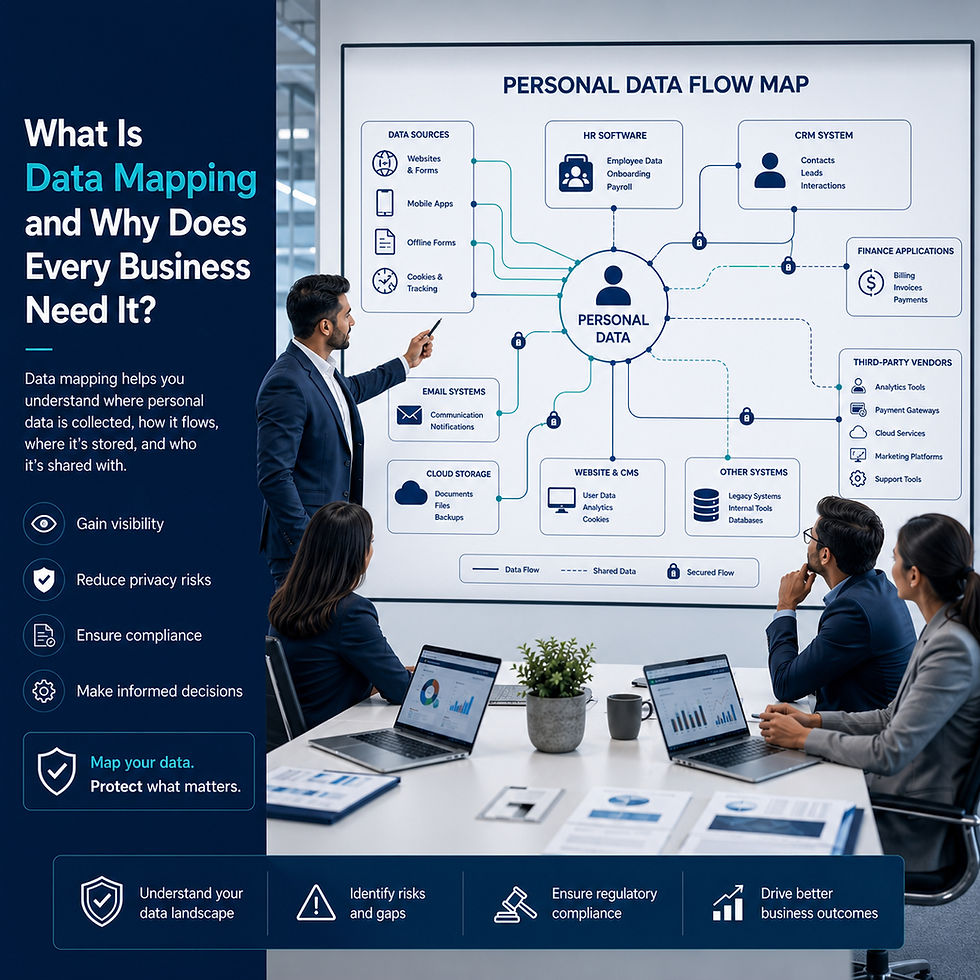
Personal data is rarely stored in just one system. It flows through departments, applications, emails, spreadsheets, cloud platforms, and third-party vendors. Unless you understand where that data is and how it moves, protecting it becomes much more difficult.
That's where data mapping comes in.
What Is Data Mapping?
Data mapping is the process of identifying how personal data moves through your organization.
It answers questions such as:
What personal data do we collect?
Where do we collect it from?
Why do we collect it?
Where is it stored?
Who has access to it?
Who do we share it with?
How long do we keep it?
When and how is it deleted?
Think of it as creating a map of your organization's personal data from the moment it is collected until it is no longer needed.
Why Is Data Mapping Important?
Most businesses collect personal data every day without giving much thought to where it goes afterwards. A customer's contact details may begin as a website enquiry, move into a CRM, be shared with the sales team, passed to finance for invoicing, and later stored for customer support.
Similarly, employee information may be collected during recruitment, transferred into HR systems, shared with payroll providers, and archived after an employee leaves. Without documenting these journeys, organizations often lose visibility over how personal data is being handled.
The Risks of Not Knowing
When personal data is scattered across multiple systems, everyday tasks become more difficult.
Imagine if someone asks:
"What personal data do you hold about me?"
"Please update my information."
"Delete my personal data."
If you don't know where that information is stored, responding accurately can become a challenge.
The same issue arises during a data breach. If an incident affects a shared drive or cloud application, you need to quickly understand what personal data was involved and who might be affected. Without a clear data map, these situations can become time-consuming and disruptive.
It's More Than an IT Exercise
Many organizations assume data mapping is a technical project. In reality, it involves the entire business.
HR manages employee records.
Sales collects customer information.
Marketing gathers data through campaigns and events.
Finance processes payment and billing details.
Operations often maintain vendor and visitor records.
Each department contributes a piece of the overall picture. Building a complete data map requires collaboration across these teams.
What Does a Data Map Typically Include?
A practical data map doesn't need to be complicated.
It usually captures information such as:
The types of personal data collected
The business purpose for collecting it
The system or application where it is stored
The department responsible for it
Internal and external recipients
Retention periods
Security measures
Whether the data is shared with third parties
This information provides a clear view of how personal data is managed across the organization.
Where Should You Start?
You don't need specialized software to begin.
Start by speaking with key business functions and documenting:
What personal data they collect.
Why they collect it.
Where it is stored.
Who has access to it.
Whether it is shared with anyone else.
How long it is retained.
Even a simple spreadsheet can become the foundation of an effective data mapping exercise.
As your privacy program matures, the map can be expanded and maintained as business processes evolve.
Data mapping is often the first practical step in building a strong privacy program.
It gives organizations visibility into where personal data exists, how it moves through the business, and where potential risks may lie.
Before you can improve privacy controls, respond to requests, or strengthen governance, you need a clear understanding of your data landscape.
Knowing your data is the first step toward protecting it.


